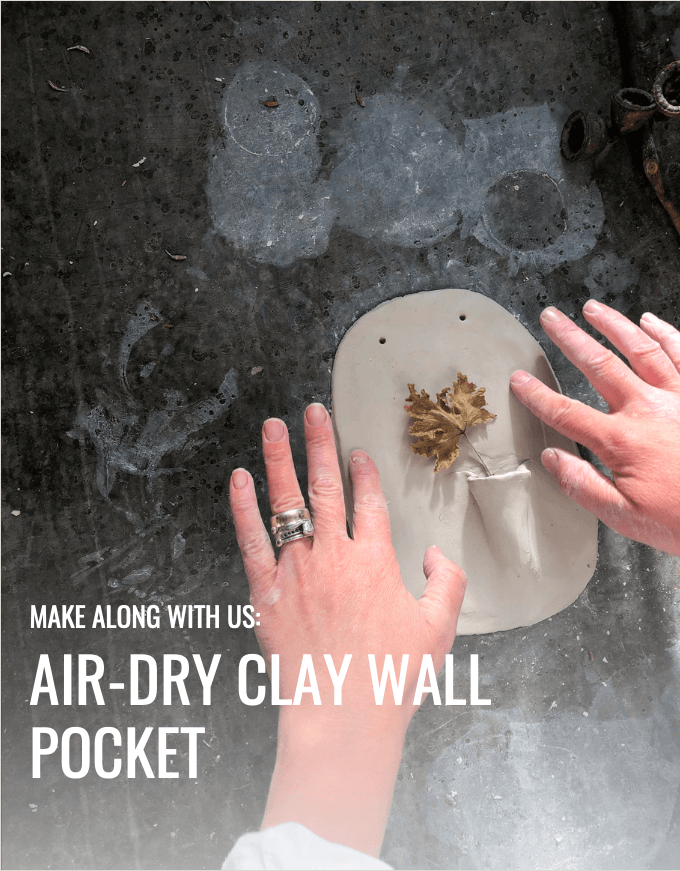
Air-Dry Clay Wall Pocket | Austin Bloom Maker
Difficulty: Beginner | Time: 30 minutes + 72 hours drying | Download: Free PDF guide
This air-dry clay wall pocket tutorial is a beautiful beginner project — a small clay vessel you can hang on your wall and fill with dried blooms, leaves or twigs foraged on your morning walk.
---
Hello there!
In the spirit of refocusing on 'making' and creativity as a regular practice, we would like to share with you another make-with-us guide, from a little while back! This air dry clay wall pocket is fairly easy; give yourself a treat and we'd love to see what you make.
Our hope is that you will find a sense of peace and meditation apart from the hustle of everyday life, as you explore creativity and working with your hands through these projects.
The wall pocket Estee made in this guide is still hanging happily on our kitchen wall and has the occasional bloom popped in it :)
With love,
Stu and Estée
---

INTRODUCTION
Inside this guide
This month we are working with air-dry clay. This gorgeous wall pocket will hang prettily on the wall in your kitchen or sit sweetly on your mantel piece.
What I love about this pocket is that it can house a few sprigs of everlasting blooms, leaves or twigs that you have foraged on your morning walk.
You may directly copy the design I have made or use it as inspiration for your own unique creation
Meet Estée

I'm Estée, one half of Austin Bloom. Before fine art prints, my world was flowers — I spent years as a florist, styling blooms for the everyday and the extraordinary. That love of natural beauty still shapes everything I create. These maker guides are my way of sharing what I've learned — simple projects that bring a little more beauty into your home.
QUICK TIPS
-
Thickness of clay
Keep your clay thickness consistent across the whole piece to avoid cracking. Have at least 1cm depth across the base for best results.
-
Glazing with Aquadhere
Kid friendly and a quick and easy way to give your wall hanging a consistent milky white satin cover. It can also protect from dust and chipping.
-
Non-porous work surface
Working on non-porous surfaces are best for clay - as these are non-stick. Marble cutting boards, smooth wood, concrete, smooth glass boards, wax paper or non-stick mats are all fine.
-
Types of fabric
We have used a beautiful checked linen - but you can use anything that inspires you! Even some Liberty fabric for some fun!
SUPPLIES
Gather your supplies

- Air dry clay
- Linen fabric
- String
- Leather strap
- Rolling pin
- Dried blooms
- Paint brush
- Non-porous work surface - e.g., wooden table/board, marble slab or concrete bench
- Aquadhere + water for glazing

STEP BY STEP
Let the making begin!
-
Roll air-dry clay into a ball
Prepare a clean, non-stick surface. Get an 8cm diameter ball
and a 5cm diameter ball of air-dry clay from the bag. We have
used MAD clay brand.
-
Roll out two shapes - base + pocket
Roll both pieces of clay into nice even flat shapes with a rolling pin. Make sure you roll evenly to prevent cracking - if rolled too thinly this can lead to breaking and cracking as the clay dries. Minimum 0.7cm -1cm thickness. The large shape is the main back plate to the design and the small shape is the ‘pocket’. Final dimensions of base plate are 14.5cm wide x 20cm high. Pocket dimension approximately 7cm
wide x 7cm high.
-
Create pocket - smoothing join
Now that you have the base plate made, carefully position your pocket onto the plate. I gently smoothed one side onto the base plate and rolled the dome pocket keeping a couple of fingers inside pocket to keep the shape whilst smoothing down the other side and base. Take your time to smooth all the joins properly - leaving no gaps.
-
Make holes for hanging + drying time
Use a skewer to put two holes approximately 2cm below the top of the base plate to create the hanger - the space between two holes is approximately 5.5cm. Now it is time for the clay to dry. This can take up to 72 hours. If you are in a hurry, I found a little blow heater speeds up this time.
-
Glazing with Aquadhere + water
The most popular reason for glazing your project is to protect it from chipping and fading. It also creates a nice consistent surface. Aquadhere is the quickest and easiest (kid-friendly too) way to glaze your wall hanging. Mix a ratio of 80% Aquadhere to 20% water to create a creamy texture. Using a paint brush paint all over the surface. Over time it may discolour and turn yellow if exposed to sun. Note that it won ’t make your clay waterproof or water resistant - only a polyurethane varnish or acrylic sealer can create a non-porous transparent layer that seals your clay project. It would only ever be water resistant though (you cannot fill your little pouch with water as the clay will break down and become soft).
-
Threading hanger + adding floral
Choose a beautiful linen fabric to tie through the holes as your hanger - 2cm wide and 40cm long at a minimum. Fold fabric in half to thread through the holes and pull gently - making a hanger that creates an 8cm space from top of base plate to hook on wall. Tie the fabric with a double knot either side once you have worked out your spacing. Now it’s time to add some dried floral to your pocket! Choose varieties like misty, little paper daisies, gum, gum nuts, dried autumn leaves.
FINAL THOUGHTS
Share yours! @austinbloom.adelaide
We hope you have found this a fun and engaging experience, which has opened your eyes to what is possible to create at home. Of course, this guide can be used over and over. We are excited for you to join us as we create more tutorials, content and inspiration!
Browse the floral and botanical collection →
You Might Also Enjoy
WIN A FRAMED A3 PRINT — EVERY WEEK
Each week we give away a beautifully framed A3 fine art print to one subscriber. Join our mailing list for your chance to win, plus early access to new collections and styling inspiration.
No spam, just art. Unsubscribe anytime.